In the hot, humid climate of New Orleans and Gretna, your air conditioner is not a luxury—it is an absolute necessity for health, safety, and basic daily comfort. When your cooling system begins to experience operational stress, ignoring the initial warning signs can quickly lead to catastrophic breakdowns during the peak of summer, skyrocketing monthly energy bills, severely compromised indoor air quality, and incredibly costly emergency repair bills.
At Zees Air Conditioning Inc., we have helped thousands of families across New Orleans, Gretna, Terrytown, Harvey, Marrero, and the entire Westbank catch mechanical issues early and avoid total system failures. This comprehensive guide provides a deep dive into the engineering, symptoms, and localized environmental factors that dictate how your cooling system behaves, empowering you to protect your home and your wallet before small issues turn into expensive disasters.
Why Early Detection Matters So Much in New Orleans & Gretna
Our unique local geography creates a relentless proving ground for HVAC engineering. The subtropical environment of Southeast Louisiana places extreme, non-stop mechanical stress on air conditioning systems that northern systems simply never experience.

Local Environmental Stress Factors
- Sustained Ambient Humidity: High relative humidity does not just make the air feel sticky; it forces your AC system to dedicate a massive portion of its energy to latent heat removal (dehumidification) rather than just sensible heat removal (lowering the actual air temperature). This moisture creates a constant film on the indoor evaporator coil, accelerating formicary corrosion—a specific type of copper tunneling corrosion—and providing a breeding ground for biological growth.
- The 9-Month Cooling Season: Unlike parts of the country where an AC runs for three months out of the year, systems in New Orleans and Gretna operate for 8 to 9 months straight, often kicking on as early as March and running deep into November. This vastly accelerates the normal wear and tear on critical moving parts like blower motors, fan blades, and compressors.
- Severe Weather and Power Surges: Frequent afternoon thunderstorms, tropical depressions, and lightning strikes across the Westbank cause subtle power fluctuations and sudden voltage spikes. These electrical events degrade the delicate control boards, contactors, and dual run capacitors inside your outdoor condenser unit over time.
- Historic Architecture Restrictions: Older homes, particularly in historic sections of Gretna and New Orleans, often feature uninsulated architectural framing, high ceilings, and unconditioned crawlspaces. These features frequently force older, retrofitted ductwork to run through scorching, unventilated attics, magnifying the effects of even minor system inefficiencies.
- Pollen and Mississippi River Dust: Heavy seasonal oak and pine pollen, combined with fine particulate dust blowing off the Mississippi River corridors, coats the ultra-fine aluminum fins of your outdoor condenser coil. This forms an insulating blanket of grime that traps heat inside the refrigerant lines, forcing the system to run longer, hotter, and under vastly higher head pressures.
The 15 Most Important Early Signs of AC Failure
1. Warm or Lukewarm Air from Vents
When your thermostat is set to “Cool” and the fan is set to “Auto,” the air exiting your supply registers should consistently register roughly 16°F to 20°F colder than the ambient air entering your return grilles. This difference is known as the temperature split. If the air feels lukewarm or room-temperature, your system is failing to execute the basic vapor-compression cycle.
- Why It Happens: This symptom is typically caused by a severe restriction in refrigerant flow, a total loss of refrigerant through a structural leak, heavily fouled coil surfaces that prevent thermal transfer, or a failing compressor that can no longer pump and compress gaseous refrigerant efficiently.
- Local Context: Because our regional humidity is so high, a minor loss in cooling capacity is immediately noticeable. Your home will cross the comfort threshold into oppressive stickiness within hours of the temperature split narrowing.
- Action Plan: Immediately check your air filter to ensure airflow is not entirely blocked. If the filter is pristine, turn off the system at the thermostat to prevent the compressor from overheating, and contact a certified technician to perform a refrigerant leak detection test.
2. Higher Than Normal Energy Bills
A sudden, unexplainable spike in your monthly Entergy bill that cannot be tied to a documented change in household behavior or an official utility rate increase is one of the most reliable fiscal indicators of impending system failure.
| Month | Baseline Energy Usage (kWh) | Failing System Usage (kWh) | Monthly Cost Variance (Est.) |
| May | 1,200 kWh | 1,450 kWh | +$35.00 |
| June | 1,600 kWh | 2,100 kWh | +$70.00 |
| July | 1,900 kWh | 2,750 kWh | +$119.00 |
| August | 2,000 kWh | 3,100 kWh | +$154.00 |
- Why It Happens: When a critical component like a TXV (Thermostatic Expansion Valve) malfunctions or the outdoor condenser fan motor slows down due to worn bearings, the system must run for drastically longer cycles to satisfy the thermostat setting.
- The Compounding Consequence: Running extended, inefficient cycles forces the compressor to draw high amperage for hours on end. This sustained electrical load rapidly degrades the internal motor winding insulation, leading directly to a catastrophic electrical short and full compressor failure.
- Action Plan: Compare your current month’s kilowatt-hour (kWh) usage against your statement from the exact same month last year. If you spot a consumption increase greater than 15% without a matching increase in outdoor temperatures, schedule a comprehensive professional AC diagnostic immediately.
3. Weak or Reduced Airflow
If you place your hand up to a supply vent and feel only a faint, lazy breeze instead of a forceful stream of conditioned air, your system’s air delivery architecture is failing. This leaves rooms furthest from the air handler completely starved of cool air.
- Common Mechanical Causes: This can be traced to a failing blower motor capacitor, a layer of thick dust coating the curved blades of the centrifugal blower wheel, a ruptured or disconnected section of flexible ductwork in the crawlspace, or an evaporator coil that has completely frozen over into a solid block of ice.
- Local Impact on the Westbank: In many older residential properties throughout Gretna and Harvey, original ductwork was insulated with low-R-value materials or held together with aging canvas duct tape. Over decades, this tape degrades, causing entire duct seams to separate and dump massive amounts of expensive, conditioned air straight into your unconditioned attic or crawlspace.
4. Strange Noises from the Unit
Modern residential cooling systems are designed to operate with a predictable, low-decibel hum. Any sudden acoustic deviation from this baseline indicates that mechanical components are undergoing structural or physical breakdown.
- Screeching or Squealing: This high-pitched sound points directly to a failing bearing inside the indoor blower motor or the outdoor condenser fan motor. In older systems, it can also signify a slipping or frayed fan belt.
- Grinding or Clanking: A severe metal-on-metal grinding sound indicates that the internal motor bearings have completely lost lubrication and failed, allowing the spinning rotor to make physical contact with the motor housing. It can also mean a fan blade has bent and is striking its safety shroud.
- Loud Clicking or Buzzing: Clicking upon startup indicates an electrical failure where a relay or contactor is desperately attempting to engage but cannot hold electrical contact. Buzzing points to a failing dual run capacitor or a loose electrical connection vibration.
- Urgency Assessment: High. Mechanical sounds never self-correct. Continued operation under these conditions will completely destroy the associated motor shaft, fan blade, or compressor housing within days.
5. Frequent On/Off Cycling (Short Cycling)
A healthy, properly sized air conditioner should run continuously for roughly 15 to 20 minutes until it reaches the exact temperature specified by your thermostat, shut down completely, and remain off for a similar duration. If your system cycles on and off every 3 to 7 minutes, it is trapped in a destructive phenomenon known as short cycling.
- The Short-Cycling Loop: System Starts $\rightarrow$ High Amperage Power Surge $\rightarrow$ Coil Freezes or High Pressure Limit Reached $\rightarrow$ System Shuts Down Prematurely $\rightarrow$ Temperature Rises Rapidly $\rightarrow$ Cycle Repeats.
- The Underlying Pathologies: Short cycling can be caused by a heavily oversized AC unit that cools the air too rapidly without extracting humidity, a faulty thermostat reading false internal temperatures, a failing high-pressure safety switch, or severely restricted airflow that triggers the internal freeze-stat sensor on your evaporator coil.
- The Long-Term Damage Profile: The single highest moment of electrical and mechanical strain on an air conditioner occurs during the initial startup seconds, when the compressor draws Locked Rotor Amps (LRA). Forcing a compressor to start up five to six times more frequently than engineered causes the internal components to overheat rapidly, drastically shortening the operational life expectancy of your system.
6. Ice or Frost on Coils or Lines
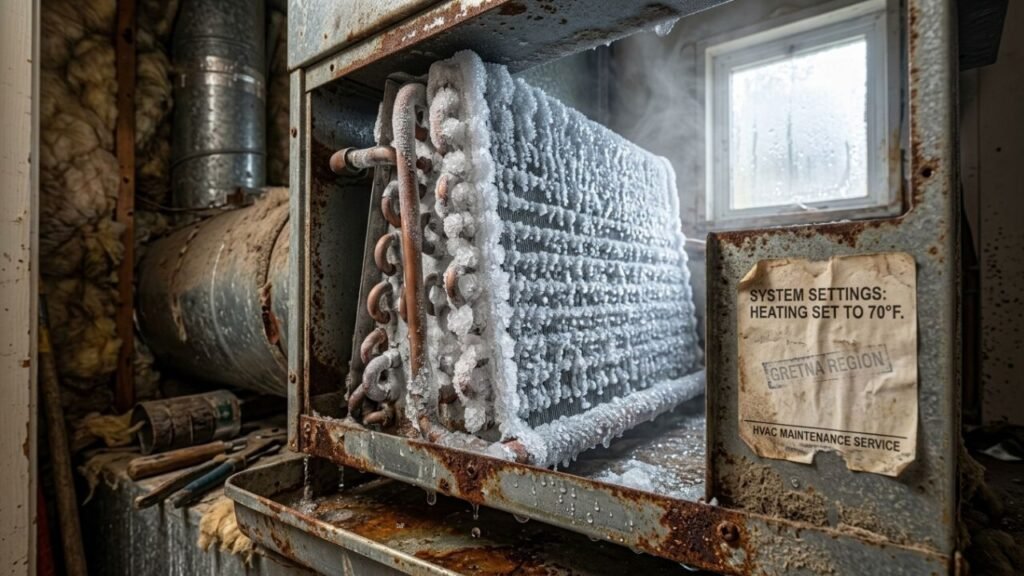
It is a common misconception that an air conditioner relies on creating freezing temperatures inside the unit to cool a home. In reality, seeing physical ice or frost accumulating on your copper suction line, exterior brass service valves, or indoor evaporator coil is an explicit sign of a critical system malfunction.
- The Physics of Air Handler Freezing: For frost to form, the temperature of the physical evaporator coil surface must drop below 32°F. This occurs either because there is insufficient air flowing across the coil to transfer heat (caused by dirty filters or broken blower motors), or because the system is low on refrigerant. Low refrigerant causes a drop in operating pressure, which lowers the boiling point of the remaining Freon well below freezing.
- The Downstream Risk Profile: When an evaporator coil turns into a solid block of ice, it completely blocks all airflow into your home. Furthermore, when that thick block of ice eventually melts, it completely overwhelms the shallow emergency drain pan, resulting in massive, catastrophic water damage to your sheetrock, ceilings, and structural floor joists.
7. Musty, Burning, or Chemical Smells
Your nose is a highly effective diagnostic tool when it comes to identifying hidden electrical and biological failures within a closed-loop ducted system.
- Musty, Earthy Odors (“Dirty Sock Syndrome”): This smell indicates that bacteria, mold spores, and fungal colonies are actively growing across the damp surfaces of your indoor evaporator coil and inside the dark, unlit interior lines of your supply plenum.
- Acrid, Burning Plastics Odor: This scent indicates that an electrical wire insulation sleeve has melted, a terminal block has shorted out, or a motor winding has completely burned out due to excessive amp draw.
- Immediate Safety Action: If you smell a distinct burning or electrical odor, immediately go to your home’s main electrical panel and flip the dedicated double-pole circuit breaker for both the indoor air handler and outdoor condenser to the “Off” position. Do not attempt to run the system until a licensed electrician or certified HVAC professional has verified its structural safety.
8. Water Leaks Around the Indoor Unit
Finding a puddle of standing water pooling around the base of your indoor air handler closet, or seeing water actively dripping down from your ceiling joists, is an explicit warning that your condensate management framework has suffered a major breakdown.
- The Local Mechanics of Condensate Overflows: Because the air in New Orleans and Gretna is incredibly humid, a standard 3-ton residential AC system can pull up to 15 to 20 gallons of water out of the air every single day. This water drains into a plastic condensate pan and out through a 3/4-inch PVC drain line.
- The Algae Problem: The warm, damp environment inside that dark PVC drain line is the perfect environment for heavy algae blooms and thick bacterial slime to thrive. Without regular maintenance, this slime forms a dense plug that completely blocks water flow, backing the water up until it overflows the internal pan boundaries.
9. Constant Running Without Proper Cooling
During the absolute hottest weeks of July and August in Southeast Louisiana, it is entirely normal for your air conditioning unit to run for long, continuous blocks of time during the late afternoon to maintain your indoor design temperature. However, if your system runs 24 hours a day without stopping, yet your home remains consistently warm and uncomfortable, the system has lost its operational capacity.
- Identifying the Primary Culprits: This state of perpetual operation is almost always driven by highly inefficient thermal transfer. This happens when the outdoor condenser coil is heavily impacted with mud and lawn clippings, the compressor valves are worn and leaking internally, or the system has suffered a significant slow leak of its refrigerant charge over the winter months.
10. Uneven Cooling (Hot Spots)
If your primary living room feels perfectly chilly, but your master bedroom or upstairs hallway feels like a virtual sauna, your home is suffering from a severe distribution imbalance or localized thermal loading issue.
- Common Structural Roots: This can point to an aging duct system where internal fiberglass insulation has completely deteriorated or collapsed. It can also mean that the duct branches were never properly sized using professional manual duct calculations (Manual D), or that your home’s thermal boundary has failed due to missing or degraded insulation in specific wall cavities.
11. Thermostat Not Responding Properly
The thermostat acts as the command center for your entire cooling apparatus. If you adjust the target temperature downward and hear absolutely nothing happen, or if the system suddenly shuts off before ever reaching your desired temperature setpoint, the communication loop is broken.
- Root Diagnostic Vectors: This can be as simple as depleted low-voltage batteries inside the thermostat housing, corroded or loose 24V control wiring (typically the R, Y, and G terminals), a miscalibrated internal digital temperature sensor, or a fried transformer inside the indoor air handler unit.
12. Visible Rust or Corrosion
Living on the Westbank or near the historic river districts means your outdoor mechanical equipment is constantly exposed to moisture, industrial particulates, and chemical compounds in the air that accelerate metal oxidation.
- The Danger of Structural Rust: Deep rust pitting on the outer steel casing of your condenser unit degrades the structural support for the heavy fan motor assembly. More critically, heavy oxidation along the copper-to-aluminum joints on your indoor coil indicates that the metal has thinned to a dangerous degree. This makes a major, non-repairable refrigerant blowout highly likely in the near future.
13. Increased Humidity Indoors
An air conditioner is mathematically engineered to perform two distinct functions: lowering the sensible air temperature and removing latent moisture. If your indoor thermometer reads 72°F but the air inside your home feels incredibly sticky, heavy, and clammy, your system is failing its dehumidification mandate.
If your indoor relative humidity levels consistently climb above 60%, your home enters a high-risk zone where dust mites multiply rapidly, and toxic mold spores can easily begin colonizing your soft furniture, clothing, and drywall.
- Why It Fails to Dehumidify: This often occurs when a system is short cycling so rapidly that the evaporator coil never stays cold long enough to reach the dew point required to condense water vapor out of the passing air stream.
14. Breaker Trips Frequently
AN electrical circuit breaker is a critical safety device engineered to interrupt the flow of electricity when an electrical circuit exceeds its safe amperage limit. If your AC unit causes its dedicated breaker to snap to the tripped position more than once, you are dealing with a severe electrical anomaly.
- Direct Mechanical Causes: This typically indicates that the compressor motor windings have experienced an insulation breakdown and are shorting to the metal grounding shell, or that the compressor is experiencing a mechanical lockup. This causes it to draw massive Locked Rotor Amps (LRA) in a desperate, failed attempt to turn over. Never reset a tripped AC breaker multiple times, as this can easily cause an electrical house fire.
15. Age of the System
In mild climates across the country, a well-maintained, premium residential air conditioner can occasionally last anywhere from 15 to 20 years. However, in the harsh, high-salinity, high-humidity air of New Orleans and Gretna, the realistic operational lifespan of an AC system is drastically compressed.
- The Reality of Regional Longevity: Once a local system passes the 10-year mark, its internal components enter a high-risk failure window. The physical coils have endured millions of expansion and contraction cycles, meaning an expensive component failure or total system replacement is often right around the corner.
How to Monitor and Track Early Signs
To protect your property, you should implement a structured tracking routine. This allows you to spot performance drift before a total mechanical breakdown occurs.
Monthly Maintenance Tracking Protocol
- Track Your Entergy Bill Consumption: Keep a rolling digital spreadsheet or a physical paper log tracking your monthly total kilowatt-hour usage against the historical averages from previous years. This helps you identify creeping utility costs early.
- Conduct an Acoustic Baseline Check: Once every month, stand directly next to your indoor air handler closet and your outdoor condenser unit while they cycle on. Listen closely for any new clicking, buzzing, or metallic vibrations.
- Monitor the Temperature Split: Purchase an inexpensive digital infrared pocket thermometer. Measure the exact temperature of the air entering your main return grille, then measure the temperature of the air exiting the nearest supply vent. Ensure the difference stays safely between 16°F and 20°F.
When to Call Professionals Immediately
While some minor issues can wait for a standard weekday service appointment, certain symptoms indicate an emergency situation that requires an immediate, professional service call.
High-Priority Emergency Indicators
- The Detection of Active Electrical Burning Smells
- Standing Water Flooding Around the Indoor Air Handler
- Visible Ice Accrual on Copper Lines or Air Handler Casings
- A Total Loss of Cooling Capacity When Outdoor Temps Exceed 90°F
- Loud, Violent Metallic Screeching or Clanking Noises Upon System Startup
If your home is experiencing any of these high-priority warning signs, do not wait for the system to fail entirely. Reach out to the emergency service division at Zees Air Conditioning Inc. to secure an immediate, comprehensive Professional Residential AC Repair diagnostic intervention.
Prevention Strategies to Avoid AC Failure

The absolute best way to handle a major air conditioning failure is to prevent it from ever happening in the first place. By taking control of your system’s maintenance schedule, you can easily extend its operational lifespan by several years.
- Maintenance Timeline: Spring Maintenance Check $\rightarrow$ Pre-Summer Filter Changes $\rightarrow$ Fall Maintenance Check $\rightarrow$ Winter Storm Protection.
- Schedule Semi-Annual Professional Maintenance: Your system needs a professional tune-up twice a year. Schedule one in the spring before the intense summer heat hits, and one in the fall to clean and prep the system for the winter heating cycles.
- Commit to Monthly Filter Replacements: Replace your standard pleated return air filters every 30 days without exception. Clogged filters are the leading cause of restricted airflow, frozen coils, and prematurely burned-out blower motors.
- Maintain Clear Condenser Perimeters: Regularly clear away all weeds, vines, creeping grass, and fallen leaves from around your outdoor condenser unit. Maintain at least a 24-inch clear radius around the entire perimeter of the machine to allow for unobstructed, radial heat rejection.
- Invest in Dedicated Whole-House Surge Protection: Install a heavy-duty, HVAC-specific surge protector directly onto the electrical disconnect box of your outdoor unit. This safeguards the delicate internal variable-speed inverter boards from the frequent power fluctuations common to the local power grid.
Real Stories from Local Homeowners
The Gretna Preventative Save
Last June, a family living in a historic home in Gretna noticed their home felt unusually sticky in the late afternoon, and their Entergy bill had climbed by $85. Our diagnostic team discovered that the system was running low on refrigerant due to a tiny pinhole leak in the evaporator coil line, which was causing the unit to short cycle. We performed a precise brazing repair, evacuated the system, recharged the eco-friendly refrigerant, and thoroughly cleared a massive accumulation of algae out of the drain line. This prompt, proactive repair saved the family from a total compressor burnout and avoided an unexpected $6,000 system replacement in the middle of a major heatwave.
The New Orleans Capacitor Intervention
A homeowner in the New Orleans Garden District noticed a strange, faint buzzing noise coming from her outdoor condenser unit. Instead of ignoring the sound, she contacted our team right away. Our technician arrived and found that the dual run capacitor was heavily bulged and running at less than 40% of its rated microfarad capacity. Because she caught this symptom early, we were able to replace the failing capacitor in under 20 minutes for a nominal fee. Had she waiting another 48 hours, the failing capacitor would have completely burned out the condenser fan and the compressor motor, resulting in well over $1,200 in catastrophic emergency damage.
Summary: Catch Problems Early
Regularly identifying the early signs of AC failure can save you thousands of dollars in premature replacement costs and keep your home safe, cool, and comfortable throughout our long, punishing summer seasons. Never ignore the early warning signs of an aging or struggling system.
The certified, licensed, and insured team of local HVAC experts at Zees Air Conditioning Inc. is standing by to help you accurately diagnose, service, and repair your system before minor issues turn into major failures.
Are you concerned about the performance, efficiency, or strange sounds coming from your home’s air conditioner? Contact our local office For Residential AC Service and secure your home’s comfort for the seasons ahead.
FAQs
Higher energy bills and weak airflow are often the first noticeable signs.
With good maintenance, 12–18 years is realistic.
Basic tasks like filter changes are safe, but refrigerant, electrical, and coil issues need professionals.
Twice per year is strongly recommended in our climate.
Yes. We provide fast, reliable service throughout Gretna and the Westbank.


