Choosing the right A/C unit for French Quarter homes is one of the most specialized mechanical challenges in Louisiana. Preserving 18th- and 19th-century masonry, complying with stringent Vieux Carré Commission (VCC) architectural guidelines, and conquering subtropical humidity require precision engineering. This authoritative guide explains historic-compliant cooling solutions, equipment pricing, and installation standards for the Vieux Carré.

Owner & Licensed Mechanical Contractor | Louisiana License #79676
The Architectural Reality of French Quarter Air Conditioning
The French Quarter (Vieux Carré) contains some of the oldest residential structures in North America, dating from the late 1700s to the mid-1800s. These Creole cottages, historic townhouses, and carriage houses were erected over a century before central air conditioning existed. Designing a modern cooling system for these properties is fundamentally different from installing an air conditioner in suburban Metairie or Kenner.
Historic French Quarter buildings feature distinct structural characteristics that impact thermal dynamics and mechanical equipment installation:
- Solid Masonry and Briquette-Entre-Poteaux Walls: Historic walls consist of post-and-brick or multi-wythe load-bearing masonry coated in soft lime plaster. Cutting into these walls for conventional sheet metal ductwork compromises structural stability and accelerates moisture migration.
- Absence of Attic Crawlspaces and Chase Ways: Most French Quarter homes feature soaring 12-to-14-foot ceilings with exposed beams and zero plenum space above ceilings. Installing bulky supply ducts often requires destroying architectural mouldings or lowering ceilings, which is prohibited under historic preservation rules.
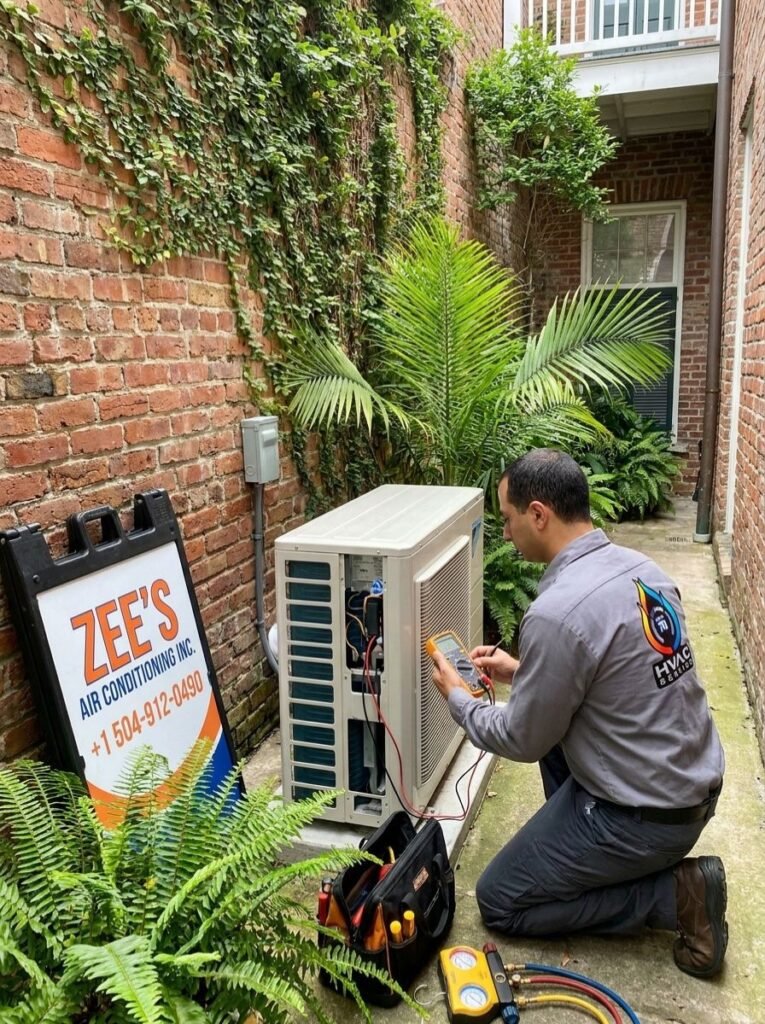
- Compact Courtyards and Sound Reverberation: Outdoor condensers cannot simply be placed on side alleys. Condensers must typically reside in intimate brick courtyards or on flat rooftops. In enclosed courtyards, condenser sound reverberates against brick walls, requiring low-decibel, inverter-driven equipment.
- Extreme Subtropical Dew Points: New Orleans summer dew points routinely exceed 74°F. In uninsulated historic brick structures, warm humid air enters constantly through single-pane cypress windows and masonry mortar joints. If an air conditioner cools the air too rapidly without extracting latent moisture, condensation forms on interior plaster, spawning mold behind historical woodwork.

Vieux Carré Commission (VCC) Guidelines for HVAC Systems
Before installing, replacing, or modifying any exterior HVAC equipment in the French Quarter, property owners must obtain approval and permits from the Vieux Carré Commission (VCC). The VCC regulates all exterior architectural elements visible from public rights-of-way, including courtyards and rooflines.
Key regulatory mandates property owners and HVAC contractors must navigate include:
- Public Visibility Restrictions: Outdoor condenser units and exterior refrigerant lines cannot be visible from the street or sidewalk. Units placed in interior courtyards must be screened from sight using architecturally approved painted louvered fences or landscaping.
- Rooftop Placement Rules: Rooftop condensers are permitted only when set back sufficiently from the roof edge so they cannot be viewed from opposing sidewalks. Ballasted mounting frames must prevent roof penetrations on historic slate and copper roofs.
- Refrigerant Line-Hide Requirements: Exterior line sets connecting indoor handlers to outdoor compressors cannot be left as bare copper or unpainted foam. Lines must be routed through architecturally compatible metal chase covers painted to match the adjacent brick or cypress siding.
- Decibel Limitations in Shared Courtyards: City of New Orleans municipal noise ordinances strictly regulate ambient sound levels in dense residential sectors. Standard single-stage compressors producing 74+ dBA can violate noise codes. Ultra-quiet inverter compressors operating below 55 dBA are the preferred standard.
Evaluating Cooling System Technologies for Historic Residences
Choosing the right A/C unit for French Quarter homes comes down to matching equipment capabilities against physical building constraints. Below is a detailed technical comparison of the three primary cooling options:
1. Ductless Mini-Split Heat Pumps (Top Recommendation)
Best For: Multi-story townhouses, Creole cottages, and properties with solid plaster or exposed joists.
Ductless mini-splits are the premier mechanical solution for the Vieux Carré. They require only a small 3-inch core penetration through brick or siding to pass power and refrigerant lines. Multiple indoor wall or ceiling cassette units connect to a single compact outdoor inverter compressor, delivering independent zone-by-zone cooling and whisper-quiet operation (19 to 24 dBA indoors).
2. High-Velocity Small-Duct Systems (Unico / SpacePak)
Best For: Larger historic residences where property owners prefer concealed supply outlets.
High-velocity systems utilize flexible, insulated 2-inch mini-ducts that snake through existing wall cavities, historic closets, and between joists without damaging architectural trim. They remove 30% more humidity than conventional systems and use discreet round termination grills that blend into historic plaster ceilings.
3. Conventional Central Ducted Split Systems
Best For: French Quarter homes with existing, uncompromised mechanical attics or previously renovated drop ceilings.
If a home already possesses sound ductwork located in a crawlspace or attic, replacing the existing central unit with a high-efficiency SEER2 variable-capacity heat pump is viable. However, retrofitting new full-size ductwork into unconditioned spaces is rarely feasible under historic preservation rules.

2026 French Quarter HVAC Cost & Investment Benchmarks
HVAC installations in the French Quarter require specialized scaffolding, historic core drilling, VCC architectural documentation, and custom mounting brackets. Below is an honest investment breakdown for residential cooling systems across the historic district:
French Quarter HVAC Replacement & Installation Estimates (2026)
Transparent Pricing for Historic Residential Systems in New Orleans
| System Configuration | Average Investment Range | Ideal Application & Features |
|---|---|---|
| Single-Zone Mini-Split (1 Indoor / 1 Outdoor) | $3,800 – $6,200 | Carriage houses, loft studios, or targeted historic master suites |
| Multi-Zone Mini-Split (3–5 Indoor Zones) | $9,500 – $18,500 | Full Creole cottages and multi-level historic townhouses |
| High-Velocity Small-Duct System | $14,000 – $24,000 | Concealed architectural cooling across 2,000+ sq ft residences |
| Complete Central Ducted Replacement | $7,500 – $13,500 | Direct replacement where existing ductwork is structurally viable |
| Comprehensive Historic System Diagnosis | $100 Flat Rate | Dedicated 60-minute multi-point electrical, airflow, and refrigerant test |
💡 Critical Sizing Rule: Manual J Calculations for Plaster & Brick
Never permit an HVAC contractor to size your French Quarter cooling system using outdated square-footage rules of thumb (e.g., “1 ton per 500 sq ft”). Solid brick and plaster walls possess enormous thermal mass that holds heat late into the night. An oversized unit will cool the air too quickly and shut off before extracting moisture, turning your home into a damp, mold-prone environment. Zees Air Conditioning performs precision Manual J load calculations accounting for masonry thickness, ceiling height, and window exposure.
Combating South Louisiana Moisture & Microbial Growth
Air conditioning in the French Quarter is as much about moisture control as temperature management. Without continuous humidity control below 55% relative humidity, historic cypress framing and decorative furnishings can suffer severe microbial contamination:
- Inverter-Driven Modulating Compressors: Variable-speed inverter systems run continuously at low speeds, sipping electricity while constantly drawing moisture across cold evaporator coils. This creates stable indoor temperatures and keeps relative humidity well within healthy levels.
- Dedicated Whole-Home Dehumidification: For large multi-level townhouses with subterranean brick ground floors, pairing a ductless or high-velocity system with an integrated dehumidifier provides year-round relative humidity stability even during rainy spring months when air conditioning is not actively calling for cooling.
- Condensate Drainage Traps & Overflow Float Switches: Condensate lines in the French Quarter must be plumbed with trap primers and dual electronic float switches. A clogged drain line in an attic or ceiling can cause catastrophic water damage to historic heart-pine flooring and irreplaceable decorative plasterwork.
Step-by-Step Historic HVAC Replacement Protocol
At Zees Air Conditioning Inc, we execute every French Quarter HVAC replacement using a disciplined 5-stage preservation protocol:
Step 1: On-Site Historic Feasibility Survey
We inspect structural joists, plaster thickness, exterior courtyard setbacks, and electrical capacity, diagnosing existing mechanical faults ($100 diagnostic checkup).
Step 2: Manual J Engineering & Equipment Selection
We calculate precise latent and sensible heat loads to match inverter multi-zone equipment to your home’s unique thermal profile.
Step 3: VCC Architectural Compliance & Permitting
We prepare line-hide routing plans, sound decibel documentation, and condenser placement diagrams to ensure compliance with city preservation standards.
Step 4: Non-Invasive Mechanical Installation
Our licensed technicians execute precision core penetrations, vibration-isolated courtyard mounts, and architectural chase covers with zero structural damage.
Step 5: Commissioning, Airflow Balancing & Testing
We calibrate refrigerant superheat and subcooling, test safety float shutoffs under pressure, and program smart thermostats for maximum energy efficiency.
Frequently Asked Questions: French Quarter HVAC Solutions
Can I install a standard central AC system in my historic French Quarter home?
Only if your property already has adequate attic or crawlspace clearances and existing duct chases. In most historic Creole cottages and masonry townhouses, installing large sheet metal ducts requires tearing out historic plaster and lowering ceilings, making ductless mini-split systems or high-velocity mini-ducts far superior.
Do I need approval from the Vieux Carré Commission to replace my air conditioner?
Yes. Any exterior modification visible from public rights-of-way—including courtyard condensers, rooftop units, and exterior line-hide covers—requires VCC architectural review and a mechanical permit from the City of New Orleans.
How loud are ductless outdoor compressors in small brick courtyards?
Modern inverter-driven multi-split compressors operate at sound levels as low as 46 to 52 dBA—comparable to the hum of a quiet household refrigerator. This eliminates the loud rattles and vibrations that cause noise complaints in enclosed courtyards.
Does Zees Air Conditioning provide duct cleaning services in the French Quarter?
No. Zees Air Conditioning Inc does not provide duct cleaning or vacuuming services. We specialize in physical duct repairs, custom mastic sealing, airflow balancing, and full HVAC system installations.
Is Zees Air Conditioning licensed and insured for historic New Orleans properties?
Yes. Zees Air Conditioning Inc is fully licensed and insured across Louisiana under State Mechanical Contractor License #79676, bringing over a decade of specialized residential and commercial HVAC expertise.
Consult With Our French Quarter HVAC Specialists
Protect your historic architectural investment with quiet, efficient, and code-compliant air conditioning. Contact Zees Air Conditioning Inc today for an expert on-site structural evaluation and transparent project quote.
705 Wright Ave, Gretna, LA 70056 | Mon–Sat: 9:00 AM – 6:00 PM (Closed Sunday)
All services dispatched on-site to your property; by appointment only, no office visits.

