During the hot, sticky summers on the Northshore, a dependable air conditioning system isn’t a luxury—it’s essential for home survival. When operating properly, your central cooling system should run in steady, predictable cooling cycles lasting anywhere from 15 to 20 minutes before powering down once your thermostat reaches its target temperature.
However, if you notice your outdoor compressor turning on, running for just two or three minutes, abruptly shutting off, and then kicking back on a few minutes later, your system is suffering from a destructive mechanical condition known as short-cycling.
Short-cycling places immense mechanical strain on your unit’s internal components, spikes your monthly utility bills, and leaves your home feeling uncomfortably warm and muggy. If you are dealing with a rapidly cycling system in St. Tammany Parish, Zees AirConditioning Inc. has created this comprehensive guide to help you understand why this happens, the damage it causes, and how to fix it before it leads to total system failure.
1. What Is Short-Cycling and Why Is It Dangerous?

Air conditioners consume the vast majority of their electrical energy during the startup phase—the initial seconds when the heavy-duty compressor motor and outdoor fan overcome inertia to start moving refrigerant.
When your air conditioner runs full 15 to 20-minute cycles, that initial energy spike is offset by a long period of steady, energy-efficient cooling. But when a system short-cycles, it experiences dozens of unnecessary startup spikes every single hour.
The Consequences of Unaddressed Short-Cycling:
- Skyrocketing Electric Bills: Constantly drawing startup amperage causes dramatic surges in your monthly electricity consumption.
- Premature Compressor Failure: The compressor is the most expensive mechanical component in your system. Repeated starting and stopping causes severe thermal friction and wear, leading to premature burnout.
- Persistent High Indoor Humidity: In Covington’s humid subtropical climate, an AC unit needs to run continuously for at least 10 to 15 minutes to pull moisture out of the air. Rapid cycles leave air feeling damp, muggy, and sticky, even if the indoor temperature drops slightly.
- Blower Motor Burnout: Repeated voltage spikes wear down capacitor contacts and overheat blower fan windings.
2. Common Cause #1: Severe Airflow Restrictions and Clogged Filters
The most common—and fortunately simplest—cause of rapid cycling is restricted airflow through the indoor air handler.
Your air conditioner operates by blowing warm indoor air across an extremely cold indoor evaporator coil. The refrigerant inside the coil absorbs heat from the air, which is then pumped outside. However, if air cannot move freely across the coil due to a clogged air filter or blocked return vents, the system cannot transfer its thermal load.
How Restricted Airflow Triggers Short-Cycling:
- Without warm room air moving across the evaporator coil, the refrigerant inside stays freezing cold.
- The temperature of the coil drops rapidly below 32°F, causing ambient humidity on the fins to freeze into solid ice.
- As ice builds up, the high-pressure and low-pressure safety switches detect dangerous pressure drops or frozen conditions.
- The system’s safety controls trip, shutting down the compressor immediately to prevent major mechanical destruction.
- Once the pressure stabilizes or ice partially melts, the system attempts to restart, repeating the loop.
3. Common Cause #2: Refrigerant Leaks and Low Pressure Safety Trips
Refrigerant is the vital chemical compound that absorbs thermal energy from inside your home and dumps it outside. Your air conditioner operates as a closed-loop system, meaning it never “consumes” or burns through refrigerant under normal conditions. If refrigerant levels are low, it means there is a physical leak somewhere in your copper lines, condenser, or evaporator coil.
When a system runs low on refrigerant:
- The pressure within the suction line drops drastically.
- Modern HVAC systems feature a Low-Pressure Cutoff Switch designed to shut down the compressor if pressure falls below safe operating levels (running a compressor without sufficient refrigerant will destroy it due to lack of lubrication).
- The system cuts power to the compressor, waits for static pressure to equalize, and then attempts to restart—causing a continuous, rapid cycling loop.
If you suspect your system is losing pressure or leaking, you should never attempt a DIY quick-fix. For certified diagnostic testing and leak repairs, homeowners across St. Tammany Parish rely on Zees AirConditioning Inc. We specialize in thorough, safety-compliant system evaluations, including custom airflow balancing and professional duct work in New Orleans, LA and surrounding Northshore communities, ensuring your system maintains ideal operating pressure year-round.
4. Common Cause #3: Oversized HVAC Equipment (“Rule of Thumb” Installs)
In the HVAC industry, bigger is definitely not better. One of the most frustrating causes of short-cycling stems from an air conditioning unit that was improperly sized during installation.
If an installer calculates cooling needs using an outdated “rule-of-thumb” based strictly on total square footage—without accounting for Covington’s high humidity, window quality, shade coverage, and ceiling heights—they will often install an oversized system.
The Oversized AC Cycle:
- An oversized unit blasts an immense volume of frigid air into your home very quickly.
- The thermostat reaches its target temperature in just 3 to 5 minutes and immediately shuts the system off.
- Because the unit only ran for 3 minutes, it had zero time to remove humidity from the air.
- The heavy, humid indoor air quickly warms the area around the thermostat back up within minutes.
- The thermostat calls for cooling again, causing the system to rapidly turn back on.
| Equipment Sizing Status | Average Cycle Length | Moisture Removal / Humidity Control | Mechanical Wear & Life Expectancy |
| Properly Sized System | 15 to 20 Minutes | Excellent (Continuous moisture condensation) | Low Wear (15 to 20 years average lifespan) |
| Oversized System | 3 to 7 Minutes | Poor (Cold but sticky, muggy indoor air) | Extreme Wear (Premature compressor burnout in 7-10 years) |
| Undersized System | Runs Continuously | Good (But struggles to reach setpoint on 95°F days) | High Wear (Overheated motor windings from continuous operation) |
5. Common Cause #4: Electrical Faults, Failing Capacitors, and Control Relays
Your air conditioner relies on a precise electrical control system to coordinate power between the thermostat, the indoor air handler, and the outdoor condensing unit. Electrical failures are a primary culprit when a system turns on and off within seconds.

Run and Start Capacitors
Capacitors act like small batteries that store electrical energy to boost and stabilize the motors in your condensing unit. The run capacitor maintains a smooth, continuous electrical current while the compressor and fan motors are operating.
In Louisiana’s extreme summer heat, capacitors degrade rapidly. When a run capacitor begins to fail or overheat, it loses its ability to hold a stable charge. The compressor motor will stumble, overheat, and trip its internal thermal overload switch, shutting the system down within seconds of startup.
Pitted Contactors and Control Relays
The contactor is an electromechanical switch that closes when your thermostat calls for cooling, sending 220 volts of electricity to the outdoor compressor. Over time, high voltage creates electrical arcing that leaves black carbon deposits or physical pitting on the contact points. Pitted contacts cause intermittent electrical connections, causing the compressor to rapidly chatter on and off.
6. Common Cause #5: Poor Thermostat Placement and Calibration Errors
Sometimes the issue isn’t with your cooling unit at all, but with the thermostat giving it incorrect commands. A condition known as thermostat micro-climatizing occurs when your wall control is installed in an improper location.
Improper Locations That Cause False Readings:
- Directly Under a Supply Air Vent: Cold air blowing directly onto the thermostat sensor fools it into thinking the entire house reached 72°F in under two minutes. It shuts the system off, the cold air dissipates, the sensor warms up, and it restarts the AC immediately.
- In Direct Sunlight: Sunlight shining through a window onto the thermostat body heats the internal sensor artificially, forcing the system to turn on repeatedly even when the rest of the home is comfortable.
- Near Hot Appliances or Kitchens: Heat from ovens, stoves, or large televisions mounted directly beneath the thermostat will fool the system into running rapid, unnecessary cooling spurts.
7. Troubleshooting Matrix: Diagnosing Your Short-Cycling AC
If your cooling unit is turning on and off rapidly, use this diagnostic matrix to narrow down potential causes before calling a professional:
- Check the Air Filter: Inspect your main return grille filter. If it is caked in dark dust, pet hair, or debris, replace it immediately with a fresh, properly rated MERV 8 to 11 filter.
- Inspect the Thermostat Battery and Display: Replace low batteries in digital thermostats. Ensure the thermostat faceplate is firmly attached to its wall mounting plate.
- Inspect the Outdoor Condenser Coil: Look at the metal fins around your outdoor AC unit. If they are covered in lawn grass clippings, dirt, or heavy mud from rain splatter, airflow is blocked, causing high-pressure safety trips.
- Observe the Operating Time: Note down exactly how long the system runs before shutting off.
- Runs for 10-30 seconds: Likely a blown capacitor, severe electrical fault, or high-pressure safety switch trip.
- Runs for 3-5 minutes: Likely an oversized system, clogged air filter, low refrigerant charge, or a thermostat placed directly under a cold supply vent.
Summary of Professional Remediation Steps

Resolving a persistent short-cycling condition follows a systematic diagnostic process executed by a licensed technician:
- Airflow and Static Pressure Inspection: The technician tests static pressure across the air handler to rule out dirty coils, closed dampers, or crushed ductwork.
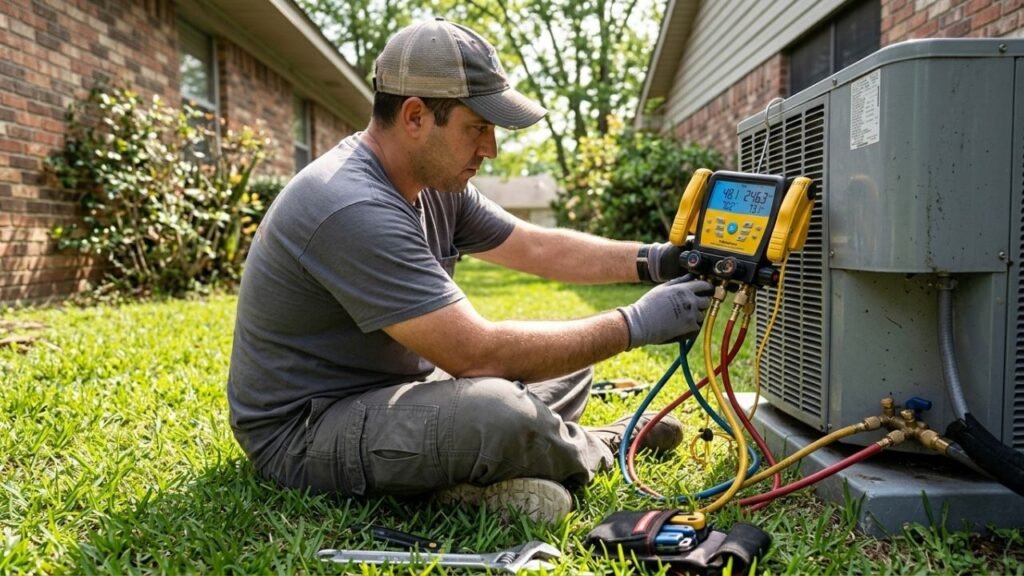
- Electrical System Diagnostics: Using a digital multimeter, the technician measures capacitor microfarad (µF) ratings, tests contactor resistance, and checks motor amp draws against factory specifications.
- Refrigerant Pressure Verification: Subcooling and superheat levels are measured to detect refrigerant leaks or thermal expansion valve (TXV) restrictions.
- Load Calculation & Equipment Matching: If no mechanical faults are found, the technician executes a formal Manual J cooling load calculation to verify if the installed tonnage matches the home’s true thermal needs.
Restore Reliable Comfort to Your Covington Home
Do not allow a short-cycling air conditioner to destroy your comfort, burn out your compressor, and double your monthly electric bills. Taking action early prevents minor electrical issues or filter clogs from turning into thousands of dollars in major equipment replacements.
If your central air conditioner is rapidly turning on and off in Covington, Mandeville, or the surrounding Northshore area, contact Zees AirConditioning Inc. today at +1 504-912-0490. Our team of certified HVAC specialists will diagnose the root cause of your short-cycling system and restore smooth, energy-efficient cooling to your home.
FAQs
No, it is not safe. Leaving a short-cycling air conditioner running causes extreme mechanical stress on the compressor motor and electrical components. Continuous rapid starting can cause the compressor to overheat, short out electrical windings, or completely seize up, turning a simple repair into an expensive full system replacement.
Yes. A heavily clogged air filter chokes off airflow to the indoor evaporator coil. Without warm room air to absorb, the refrigerant inside the coil drops below freezing, causing moisture on the coil to turn into ice. This triggers high or low-pressure safety limit switches that shut down the unit automatically to protect the system from liquid refrigerant slugging.
Under normal summer conditions in Covington, a properly sized air conditioning system should run approximately 2 to 3 times per hour, with each cooling cycle lasting roughly 15 to 20 minutes. On extremely hot days (above 95°F), the system may run longer, continuous cycles to maintain your thermostat setpoint, which is completely normal.
The cost to fix a short-cycling air conditioner depends entirely on the underlying cause. If the issue is a dirty filter, replacing it costs very little. Replacing a degraded run capacitor or pitted contactor is a standard, affordable electrical repair. However, if the short-cycling is caused by an oversized unit, correcting the issue may require adjusting blower fan speeds, redesigning ductwork, or installing a properly sized system.
High humidity increases the total heat load on your cooling system. Your air conditioner has to work twice as hard to condense water vapor out of the air before it can effectively lower the air temperature. If your system is low on refrigerant, has a dirty coil, or suffers from weak capacitors, this added moisture load will trigger safety pressure limits much faster.
A smart thermostat can help if the short-cycling is caused by improper calibration, tight temperature differential settings, or bad programming. Many modern smart thermostats include built-in cycle rate limits and minimum run-time protection features that prevent the compressor from turning back on for at least 5 minutes after powering down, protecting the system from rapid cycling.

